Room
0 - Secondary Autistic Program
Zane
Johnson 472-8973
zsjohnso@mpsaz.org
Room
1 - Alternative Learning Center
Room
3 - Elementary ED Program
Room
4 - Elementary ED Program
Room
5 - Elementary MI/MO Program
Room
7 - Junior High MI/MO Program
Room
8 - Elementary Autistic Program
Room
9 - Secondary ED Program
Debra
Frederickson 472-8494
Room
18- Elementary ED Program
|
Mission Statement
Strive
to Do Your Best
Home
and School Partnership
Attend
School for Success
Respect
Ourselves and Others
Promote
Citizenship
Program
Description
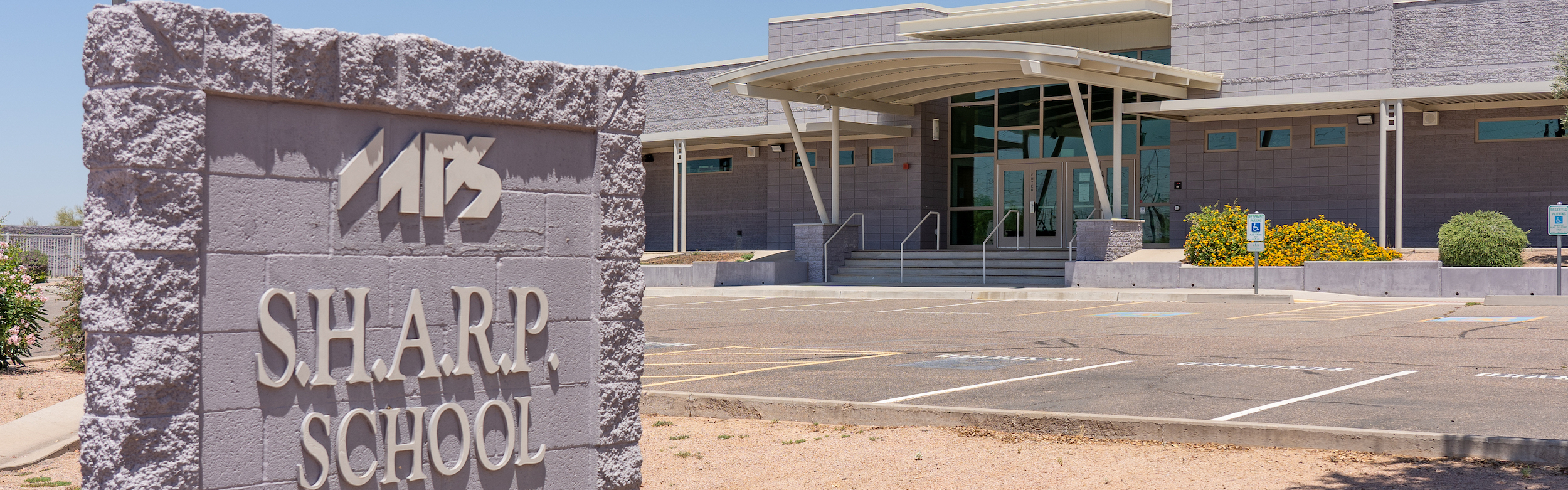
SHARP
School is a day school alternative program for students with Emotional
Disabilities (ED), Mild or Moderate Mental Disabilities (MIMD, MOMD) or
Autism. SHARP School is a highly structured, self-contained campus serving
Special Education students who have been referred to the program from
a comprehensive school in the Mesa Public School District due to significant
behavior problems. In addition, the SHARP campus provides programs to
address the needs of students returning to a public school setting from
a Residential Treatment Center (RTC) or from prolonged hospitalization.
This program is a more restrictive placement for Special Education students
designed to facilitate changes in behaviors and family dynamics necessary
for a successful transition back to a comprehensive campus. SHARP School
utilizes an individualized 24 hour day plan for meeting each student's
educational needs. SHARP School also houses the Transition Campus, consisting
of the Vocational Exploration Program (VEP), the Sheltered Employment
Training Program (SET), and the Home Education Learning Program (HELP).
These classes are designed to provide vocational training and experience
to Special Education students engaged in functional programming from the
six comprehensive high school campuses in Mesa Schools.
Return
to the Top
Dress
Code
The
dress code at SHARP School conforms with the Mesa Public Schools' Governing
Board Policy JFCA regarding student dress and grooming standards. Student
dress and grooming standards are established to promote the general health,
safety and welfare of all students and staff and directly contribute to
the accomplishment of the district's educational objectives. These objectives
include:
- Creating
and maintaining a safe and orderly learning environment,
- Achieving
district curriculum standards and objectives,
- Fostering
school pride and student self-esteem, and
- Adhering
to social norms in preparation for future education and employment
opportunities.
School
administrators and teachers have the professional responsibility and authority
to require students to change their dress or grooming to comply with the
district and school dress and grooming standards.
General
Standards
Personal
appearance and dress are the responsibility of the student and the student's
parent or guardian. Students will not dress or groom themselves in a manner
that, in the judgment of the school administrator, presents a risk to
the health, safety or general welfare of the student, other students or
staff, or that is counterproductive to the district's educational objectives.
Students will refrain from displaying tattoos or wearing clothing, jewelry
or other accessories that communicate, whether through language, images,
symbols, artwork, color schemes or clothing styles:
- A message
that advocates or promotes violence or terror;
- A message
that is sexually suggestive, vulgar, obscene or plainly offensive;
- A message
that would cause a reasonable person, as a student or a staff member,
to feel insulted, demeaned, threatened, intimidated or harassed because
of the person's race, ethnicity, religion, gender or sexual orientation;
or
- A message
expressing
gang membership, affiliation or support.
Dress
Standards
Students
at SHARP School must comply with the following dress standards at school
and school events:
-
Jeans,
pants and trousers must be worn at the waist area and must not drag
excessively on the ground. No Sagging is Allowed!
-
Clothing
must cover the abdomen, back, buttocks, chest and genital areas. Tops
that expose cleavage are prohibited. When standing, tops must completely
cover the midriff to the skirt, shorts or pants. If an untucked top
falls below fingertip level when the student is standing, the top
must be tucked into the trousers.
- Skintight
outer clothing, such as spandex, is probibited unless it is worn for
a school-sponsored extracurricular activity.
- Tube
tops and halter tops are prohibited. Tank tops and other sleeveless
tops are permitted only if the straps are wider than one and one-half
inches and the armholes are no lower than two inches from the armpit.
- Shorts
must have at least a two inch inseam and extend to the tip of the
student's fingers.
- Dresses
and skirts must extend at least one inch beyond the tip of the student's
fingers.
- Clothing
or attire by which an adolescent female student does not wear a bra
or underwear, wears a bra or garments as outerwear, or wears clothing
in a manner such that underwear is visible through outerwear is prohibited.
- Clothing
or attire by which an adolescent male student does not wear underwear,
wears underwear as outerwear, or wears trousers or shorts so that
underwear is visible is prohibited.
- Pajamas
and other sleepwear are prohibited.
- Bandanas,
hairnets and do-rags are prohibited.
- Jewelry
and accessories with studs, spikes, sharp objects or heavy chains
are prohibited. In addition, jewelry depicting weapons (ie. brass
knuckles), illegal drugs, offensive symbols or sexually suggestive
material is prohibited.
- Sunglasses
may only be worn outside unless a medical condition exists that is
confirmed by a physician.
- Hats
or other head apparel may not be worn inside school buildings unless
for religious, medical or safety purposes. Students will not be prohibited
or discouraged from wearing hats or other clothing designed to reduce
sun exposure while outdoors.
- Trench
coats and other oversized clothing that can conceal contraband are
prohibited.
- Footwear
must be worn at all times. Shoes, such as "wheels in the heels,"
that pose safety hazards and shoes, such as cleats, that may damage
flooring are prohibited.
Grooming
Standards
SHARP
Students must comply with the following grooming standards at school and
school events:
- Students
are expected to bathe and groom themselves regularly so that any lack
of personal hygiene is not annoying or disruptive to other students
or staff.
- Secondary
students my use cosmetics. Heavy mascara and other use of cosmetics
that give the student a disturbing or distracting appearance is prohibited.
Face paint is prohibited.
Compliance
with Standards
SHARP
School students who violate the dress and grooming standards must correct
the violation immediately. Appropriate remedies may include, but not be
limited to:
- Turning
inappropriate clothing inside out.
- Changing
to appropropriate clothing provided from home or by the school.
- Removing
offending jewelry or accessory.
The
SHARP Principal reserves the right to confiscate contraband clothing items,
accessories or jewelry to be held until such time as the offending student's
parent schedules a meeting with the Principal to retrieve the item. Students
who refuse or are unable to correct the violation will spend the remainder
of the school day in the Alternative Learning Center. Subsequent violations
will be addressed in accordance with the district's Information &
Guidelines for student behavior.
Return
to the Top
The
SHARP School Day
The
SHARP School day begins each morning at 7:30 AM. Students are greeted
off the buses and directed to their classrooms. Attendance and other clerical
duties are completed and students are escorted to breakfast. At 8:00 AM,
daily announcements are made over the public address system, including
the Pledge of Allegiance, announcment of student(s) of the day and other
important information. Immediately following announcements, academic instruction
begins. In addition to classroom instruction, students receive Physical
Education, Creative Arts and Media Center at various times during the
week. SHARP School has three different lunch periods that are grouped
based on age group. Lunches begin at 11:00 AM and continue through 12:30
PM. Dismissal time on Monday, Tuesday, Thursday and Friday is 1:45 PM.
Wednesday is early release day for professional development activities
and dismissal time on Wednesday is 1:15 PM.
Return
to the Top
Attendance
and Absences
Consistent
attendance at school is vital for the student to receive educational benefit.
To that end, SHARP School is committed to assisting parents in ensuring
that each student is at school working to enhance and improve their academic
and behavioral skills. Arizona Revised Statutes require parents to notify
the school in advance of or the time of a student's absence. In addition,
MPS transportation should be called so that the student's school bus will
not make an unnecessary trip.
The
SHARP School Attendance line is 480-472-8960. If a student is absent from
school and the school has not been notified, a follow up call will be
made, either to the home or the parent's place of work, to determine the
reason for the absence. In the event that no one can be contacted, the
absence will be recorded as unexcused. A meeting with the parents, school
administration and staff may occur if a student is recording excessive
absences. School Board policy requires that absences from school be for
"necessary and important reasons, including, but not limited to,
illness, bereavement, other family emergencies and observance of major
religious holidays fo the family's faith." Please make every attempt
to see that your child is in school!
Return
to the Top
Discipline
Plans
All
privileges at SHARP School are earned through good behavior, including
outdoor recess time, indoor free time, computer time, etc. Students earn
points during each classroom segment for being prepared to work, completing
their work and "being a student". Being a student is defined
as sitting quietly in his/her seat; raising a hand for permission to leave
his/her seat, to speak, or receive help; not disturbing others; paying
attention; following directions; and being courteous. SHARP teachers are
recording all instances and types of out of compliance behavior on a data
sheet during each time segment.
Students
receive feedback from the teacher after each time segment, providing the
student with frequent cues throughout the day regarding their behavior.
At the conclusion of the day, behavior point totals are tallied and recorded
in the students' "Behavior Bank Account". Students enter their
point totals into a checkbook ledger to track their accounts. At the end
of the week, the student can write a check against their behavior account
in the SHARP School Store toward the purchase of various items of value,
such as CD's, frisbees, table games, basketballs, toiletries, etc. Students
have the option of spending their behavior points on any given week or
they can bank their points to save up for an item of greater value. In
this way, students not only learn that positive behavior is rewarded,
they develop concepts such as saving and spending.
Each
student receives a daily student behavior report that is brought home,
indicating how the student behaved at school and on the bus each day.
A section of the behavior report is reserved for the parent to report
back to the school on the student's behavior at home. The student will
earn bonus points for returning the behavior report back to his/her teacher
the following morning. The report will indicate that the student earned
either a Plan A or a Plan B. These plans are based on the total number
of behavior points that the student earns each day. For example, an elementary
student who earns between 135 and 150 points per day has an excellent
and earns a Plan A. A student who earns between 134 and 120 points has
a good day and earns a Plan A. A student who earns between 119 and 106
has an average day and earns a Plan A. A student who earns 105 points
or less in a day has had a poor day and earns a Plan B. A Plan B is an
indication to the parent that the student has not earned extra privileges
at home, such as watching TV, playing video games, etc.
Students
whose behavior is disruptive of the educational setting, shall be removed
to a time out area within the classroom. The student is given a designated
amount of time to de-escalate and return to the classroom setting. If
the student exhibits behavior that poses a threat to the welfare of themselves
or others, damages property or does not de-escalate while in time-out,
the student will be immediately moved to the Alternative Learning Center
(ALC) on campus. ALC is designed to provide each student with a quiet,
isolated area in which the student can calm themselves. A student must
earn his/her way out of ALC through positive behavior and completing work
assignments before they can return to the classroom setting. If a student
does not earn a determined amount of points in ALC before the conclusion
of the school day, the student will have earned another day in ALC.
The
focus of all of the behavior plans at SHARP School is working closely
with the parents/guardians to develop a consistent program that promotes
and rewards the positive behaviors that will assist the student in making
a successful transition back to a comprehensive campus.
Return
to the Top
Phasing
Procedure
One
of the primary goals of the SHARP School program is to assist students
in developing appropriate behavioral skills that will enable the student
to slowly phase back to a comprehensive campus. This process will continue
until such time as each student is a full time participant in the regular
school community, complying with rules and deriving benefits from classroom
instruction.
When
the teacher of a SHARP Student determines that a student has met the criteria
to be considered for phasing, the teacher will complete the Functional
Programming Skills Checklist or the ED Programming Skills Checklist, depending
on the student's program. When the appropriate checklist has been completed,
the SHARP teacher will initiate contact with the Phase Liaison, whose
responsibility it is to oversee the successful transition of all students
from SHARP back to the comprehensive campus.
The
Phase Liaison will review the documentation with the program Demonstration
Teacher to determine the appropriateness of the phase proposal and identify
a potential receiving school for the student. The Demonstration Teacher
is tasked with contacting the Regional Director who facilitates the placement
by finalizing the selection of the phasing school site and teacher with
the appropriate principal and teacher. The Demonstration Teacher will
then contact the Phase Liaison, verifying the name of the receiving school
and teacher.
It
is at this point that the Phase Liaison, SHARP School teacher and receiving
school teacher take over the process. The SHARP School teacher will follow
all necessary procedures and safeguards to arrange a case conference with
all appropriate IEP Team members. Informal discussions can occur with
the parents, the receiving school and SHARP staff prior to the case conference.
In the case conference, participants will discuss the student's academics
and behavioral strategies; the amount of time for the initial phase; a
potential timeline for the phase; a communication format to relay progress
information to parents, receiving school and SHARP School; duplication
of records; and transportation issues.
The
receiving teacher will receive the skills checklist, IEP, data sheets
and any other information necessary to insure the success of the phase.
While the phase is in progress, SHARP School will remain the school of
record so, in the event of problems, the student can immediately return
to SHARP full-time. During the phasing process, the Phase Liaison will
monitor the performance of the student, conferring with both the receiving
teacher and the SHARP School teacher. It is the responsibility of the
Phase Liaison, in consult with the other teachers, to recommend alterations
in the phasing program for a child, either increasing or decreasing the
phase time.
If
the phasing process has been successful and the transition has been considered
appropriate, the Phase Liaison will coordinate the scheduling of a meeting
of the IEP team. All IEP Team Members will meet at the receiving school
to change the student's Least Restrictive Environment (LRE) designation
from Private Day School to Self-Contained Classroom on a regular campus.
It is at this point that the student officially becomes a student on the
comprehensive campus!
Return
to the Top
From
the School Nurse
School
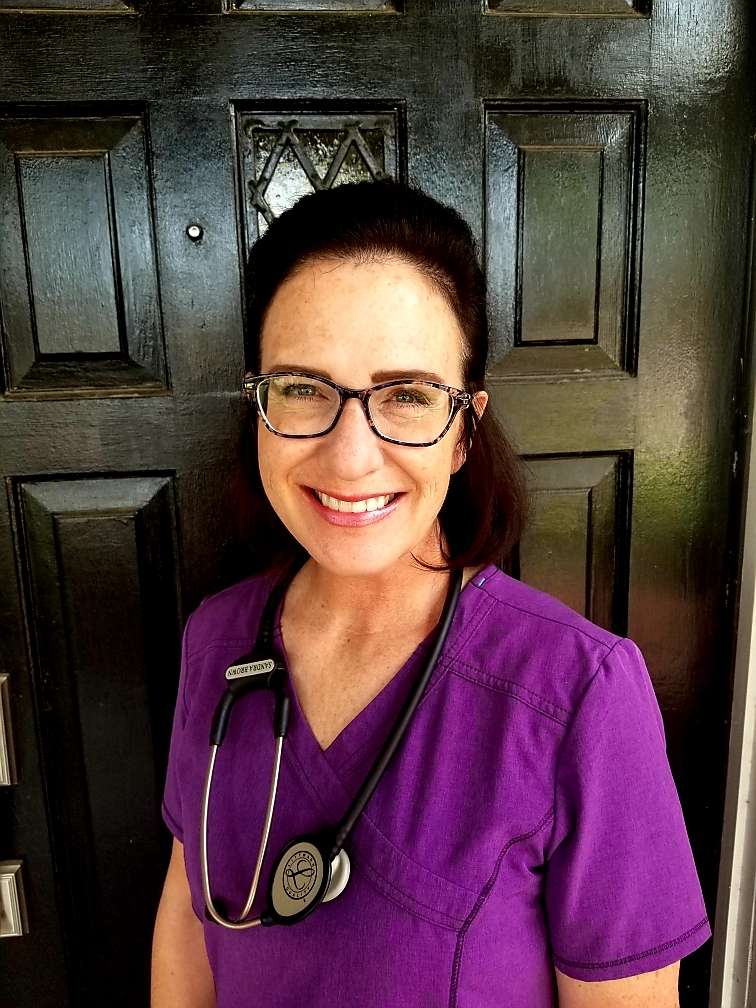
Nurse Michele Romanoski
Is
your Child Sick? Should he/she be sent to school?
Fever
A fever is a warning that all is not right with the body. The best way
to check for fever is with a thermometer. No child with a temperature
over 100 degrees should be sent to school. Do not let your child return
to school until there has been no fever for 24 hours.
Head
Lice
A child with head lice must remain at home until the child's hair has
been treated with lice shampoo and the nits have all been removed from
the child's hair. The entire household needs to be cleaned, including
all clothing, sheets, bedspreads, pillow cases and towels. Please call
the school nurse and report whenever a child has head lice so the nurse
can check the child's classmates and those of his brothers or sisters.
Stomachache,
Vomiting, Diarrhea
Consult your doctor if your child has a stomachache which does not seem
to go away and is severe enough to limit activities. If repeated vomiting
occurs, keep your child home until food can be kept down. A child with
repeated diarrhea should be kept home. Call your doctor if the child does
not appear to improving over time.
Headache,
Earache
A child whose only complaint is a headache does not need to be kept home.
However, if the headache is accompanied by other symptoms, such as stomachache
or vomiting, it would be wise to consult your doctor. If the child complains
of an earache for more than 24 hours, consult your doctor right away.
Eye
Infections
Reddened, irritated eyes with drainage may be conjunctivitis or pink eye
and must be treated by a doctor. A child with pink eye must be on medication
for at least 24 hours before returning to school.
Colds,
Sore Throat, Cough
The common cold is the most frequent problem for parents to deal with.
A child with a "mild" cold but otherwise feeling well may be
sent to school. A child with a "heavy" cold, one characterized
by sinus drainage and a deep, hacking cough, should be kept home. Consult
your family doctor if there is no improvement over a 24 hour period. If
your child complains only of a sore throat with no other symptoms, the
child may be sent to school. However, if white spots can be observed in
the back of the child's throat or the sore throat is accompanied by a
fever, keep the child home and call the family doctor. If your child is
being treated for Strep Throat, the child should stay home until there
is no fever for 24 hours and antibiotics have been in use for at least
24 hours.
Return
to the Top
Transition
Campus
A
part of SHARP School is the Transition Campus which consists of the Vocational
Exploration Program (VEP); the Sheltered Employment Training Program (SET);
and the Home Education Learning Program (HELP). Each of these programs
is designed to address the issue of preparing our Special Education students
for the transition to adult living. Students involved in functional programming
at each of Mesa Public Schools' six comprehensive high schools have the
opportunity to participate in one of the three programs for 1/2 of their
academic day. Students are either bussed from their home to the Transition
Campus for the morning session and then return to their home school or
students are bussed from their home school to the afternoon session and
returned home at the end of the day. The HELP Program is designed to provide
functional students with skills of daily living such as cooking, cleaning,
laundering, etc. The SET Program is designed to expose functional students
to a Sheltered Workshop setting, including the skills of sorting, collating,
packaging, etc. The VEP Program is designed to provide functional students
with exposure to community based employment opportunities.
Return
to the Top
|